
Prepare the development environment
Section titled “Prepare the development environment”- Download the Arduino IDE from https://www.arduino.cc/en/software
- Install the ESP core according to your target:
- If using ESP8266
- If using ESP32
- Copy the content of the libraries directory to your Arduino libraries directory.
Open esp3d/esp3d.ino in Arduino IDE
Section titled “Open esp3d/esp3d.ino in Arduino IDE”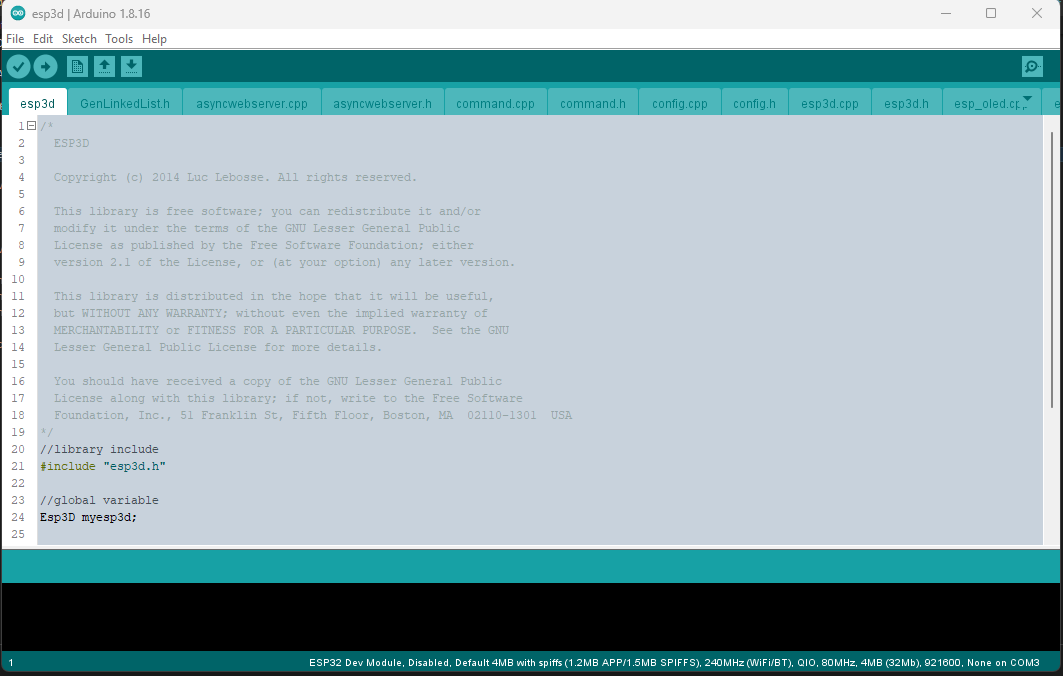
Configure ESP3D
Section titled “Configure ESP3D”See the Configuration page.
Configure Flash settings
Section titled “Configure Flash settings”For ESP8266 with 4MB flash
Section titled “For ESP8266 with 4MB flash”- Board: Generic ESP8266 Module
- Upload Speed: 115200
- CPU frequency: 160 MHz
- Flash Size: 4M (2M SPIFFS)
- Flash Mode: DIO
- Flash Frequency: 40MHz
- Reset Method: CK
- Debug Port: Disabled
- Debug Level: None
For ESP8266 with 1MB flash (this board may not support Web Update due to limited flash size)
Section titled “For ESP8266 with 1MB flash (this board may not support Web Update due to limited flash size)”- Board: Generic ESP8266 Module
- Upload Speed: 115200
- CPU frequency: 160 MHz
- Flash Size: 1M (128K SPIFFS)
- Flash Mode: DIO
- Flash Frequency: 40MHz
- Reset Method: CK
- Debug Port: Disabled
- Debug Level: None
For ESP32 with 4MB flash
Section titled “For ESP32 with 4MB flash”- Board: ESP32 Dev Module
- Upload Speed: 115200
- CPU frequency: 240 MHz
- Flash Frequency: 80MHz
- Flash Mode: QIO
- Flash Size: 4MB
- Partition Scheme: Default 4MB with SPIFFS
- Core Debug Level: None
- PSRAM: Disabled
Connect your board
Section titled “Connect your board”Check the hardware section for more information.
Compile and flash your module
Section titled “Compile and flash your module”Select the port your device is connected to and choose Upload from the sketch menu to compile and flash.